
Project Overview
Location: Bluffton, SC
Date of Loss: May 21, 2025
Loss Type: Water damage from dishwasher leak
Insurance Carrier: Major national insurer
Water Category: Category 1 (clean water)
Property Type: Residential single-family home
Initial Assessment
Source of Loss
The water damage originated from a dishwasher leak in the kitchen, affecting laminate flooring and kitchen cabinets. The leak was discovered by the homeowner on the morning of May 21, 2025, with the claim created the same day, demonstrating prompt reporting.
Affected Areas
- Primary Impact Zone: Kitchen (77 ft²)
- Secondary Impact: Living room (minimal)
- Materials Affected: Laminate flooring, kitchen cabinetry, drywall, and concrete subflooring
Technical Documentation and Monitoring
Initial Moisture Readings (May 21, 1:13-1:18 PM)
Environmental Conditions:
- Kitchen: 61% RH, 84.7 gpp, 77°F
- Exterior: 57% RH, 113.7 gpp, 88°F
- Unaffected living room: 43% RH, 50.1 gpp, 72°F
Material Moisture Levels:
- Point 1 (Concrete): 99% moisture content
- Point 2 (Drywall): 99 points
- Point 3 (Plywood): 96 points
Final Readings (May 23, 9:45 AM)
Environmental Conditions:
- Kitchen: 45% RH, 60.1 gpp, 76°F
- Exterior: 54% RH, 74.8 gpp, 77°F
- Unaffected living room: 48% RH, 56 gpp, 72°F
Material Moisture Levels:
- Point 1 (Concrete): 12% moisture content (Achieved dry standard)
- Point 2 (Drywall): 9 points (Achieved dry standard)
- Point 3 (Plywood): 10 points (Achieved dry standard)
Equipment Deployment Strategy
Dehumidification
Equipment: Dri-Eaz Revolution LGR Dehumidifier
Capacity: 44 pints/day (recommended: 33 pints/day for 1,382 ft³)
Performance:
- Initial: 18% RH, 102°F discharge, 30 gpp grain depression
- Final: 16% RH, 97°F discharge, 19 gpp grain depression
Air Movement
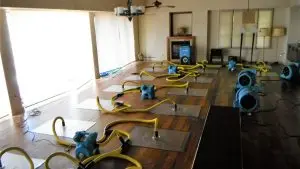
Equipment: Five Jon Don Low Profile Air Movers (LPA1000)
Configuration: 3 units recommended for 77 ft² area (deployed 5 for enhanced drying)
Power Consumption: 0.23 kW per unit
Drying Process Analysis
Timeline
- Day 1 (May 21): Initial assessment, equipment placement
- Day 3 (May 23): Final readings, drying goals achieved
- Total Drying Time: 48 hours
Drying Goals vs. Achievement
- Concrete: Goal 16.5% → Achieved 12%
- Drywall: Goal 15.4 points → Achieved 9 points
- Plywood: Goal 15.4 points → Achieved 10 points
Equipment Performance Metrics
Energy Consumption Analysis
Dehumidifier (93 days on site):
- Power: 0.71 kW
- Total consumption: 1,576.03 kWh
- Average daily: 16.95 kWh
Air Movers (variable deployment):
- Individual power: 0.23 kW each
- Deployment strategy: Staged removal based on drying progress
- Three units removed after 5 days once structural drying achieved
Key Success Factors
Rapid Response
The claim was created and initial response occurred on the same day as the loss discovery, preventing secondary damage and microbial growth potential.
Proper Classification
Correctly identifying the water as Category 1 (clean) allowed for appropriate restoration procedures rather than more extensive remediation protocols.
Strategic Equipment Placement
Deploying equipment beyond minimum recommendations (5 air movers vs. 3 recommended) accelerated the drying process, achieving dry standards in just 48 hours.
Environmental Monitoring
Continuous monitoring of both affected and unaffected areas provided clear documentation of the drying progress and ensured no migration of moisture to adjacent areas.
Documentation Protocola
Photography
- 41 photos taken across multiple sessions
- Initial documentation on May 21
- Progress documentation on May 23
- Comprehensive coverage of kitchen and living room areas
Video Documentation
Video evidence captured during initial assessment provided additional context for the scope and nature of the damage.
Project Outcomes
Technical Success
All materials achieved or exceeded drying goals within 48 hours, demonstrating effective moisture extraction and preventing potential secondary damage.
Operational Efficiency
The strategic deployment of equipment and systematic monitoring protocols resulted in a successful restoration with minimal disruption to the homeowner.
Cost Management
While specific costs aren’t detailed, the rapid drying timeline likely minimized labor costs and reduced the risk of additional damage that could have increased project scope.
Lessons Learned
- Early intervention is critical – Same-day response prevented escalation
- Over-specification of air movement can significantly reduce drying time
- Systematic monitoring provides clear documentation for all stakeholders
- Category 1 water damage responds well to standard drying protocols when addressed promptly
This case demonstrates best practices in water damage restoration, from initial assessment through successful completion, serving as a model for similar residential water loss scenarios.